Clozd · 2024–25
A feedback engine for win-loss
Clozd helps companies learn why they win and lose deals. I led design for Workflows, the engine that collects participants and runs outreach across feedback channels.
Problem
Collecting participants and running outreach for win-loss interviews and surveys was manual and slow.
What I did
Proposed the scope reset that got the project unstuck, designed the workflow engine, and led the team through launch when it had no product manager.
Outcome
The MVP launched 4 months after the reset. A quarter of customers set up a workflow, and those who did churned 7% less than those who didn't.
- 7% lower churn among adopters (30% → 28%)
- 25% of customers set up a workflow
- 52 → 79 companies logging in 10+ times per 90 days
- 4 mo from scope reset to MVP
The problem
Clozd customers ran win-loss programs: interviews and surveys with buyers about why a deal was won or lost. To stay, a customer needed to complete at least 75% of their program. The top reason they fell short was simple: not enough buyers to talk to.
Deals came in from the customer’s CRM, but turning them into a list of people to contact happened outside Clozd. Customer teams built lists in spreadsheets and passed them around to confirm they had the right contacts. That could take up to six weeks, and it often still ended with too few contacts for useful feedback.
The automation that did exist made things worse. It was hard to configure, and nobody could see who was getting contacted or why, so neither customers nor Clozd’s own consultants trusted it.
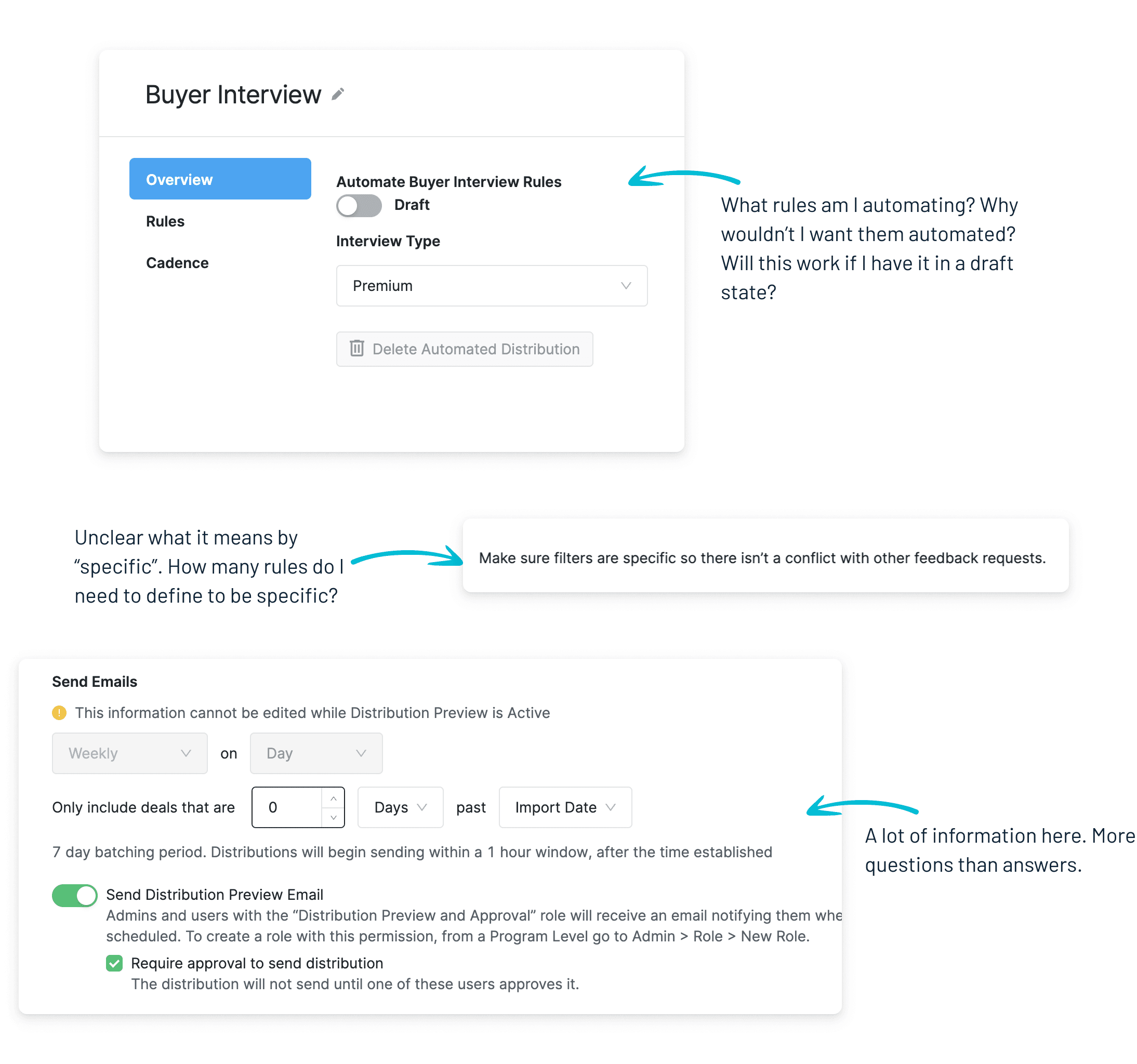
My audit of the old automation settings. Every screen raised more questions than it answered.
My role
I was the only designer, alongside four engineers. When the team had no product manager, I led it through launch as well. I ran Workflows for a year, from discovery through the second release.
Getting unstuck
Discovery had run for six months without converging. Each pass at the long-term vision got bigger, and nothing was getting built.
I proposed cutting scope to the smallest piece customers could use, then building the rest in phases. I presented the plan to leadership with mockups showing what the first release would look like, and they approved it.
- Phase 1, the MVP: participant lists and approvals moved into Clozd. It shipped four months after the reset.
- Beta: customers used it for 2–4 weeks. It confirmed the approach and needed only minor tweaks.
- Phase 2: automated data collection, approvals, notifications, and outreach.
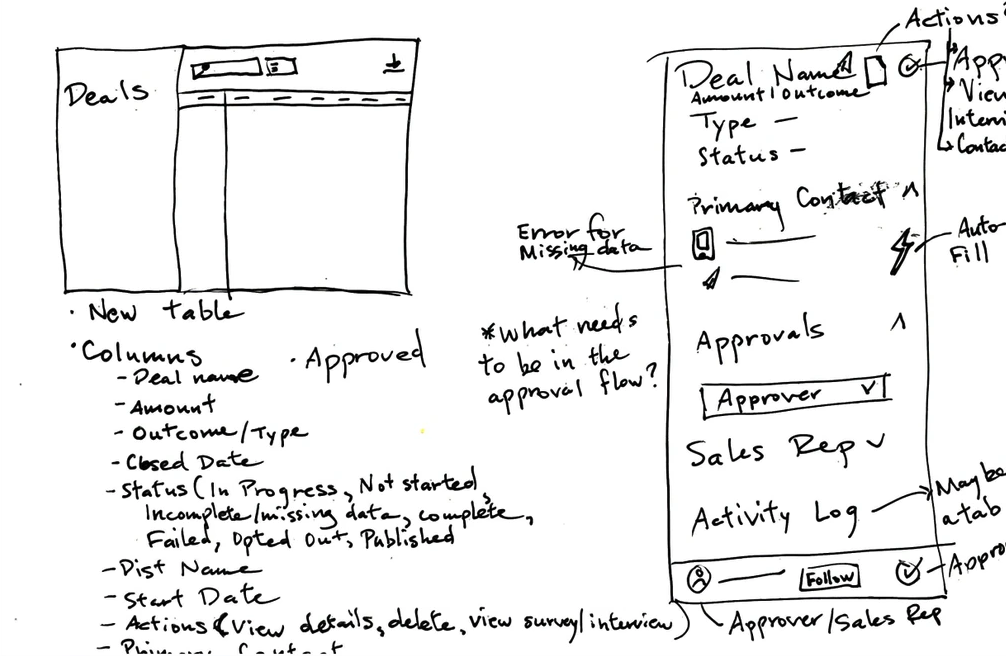
An early sketch of the deals table and deal drawer: the statuses a deal can be in, errors for missing contact data, and who approves it.
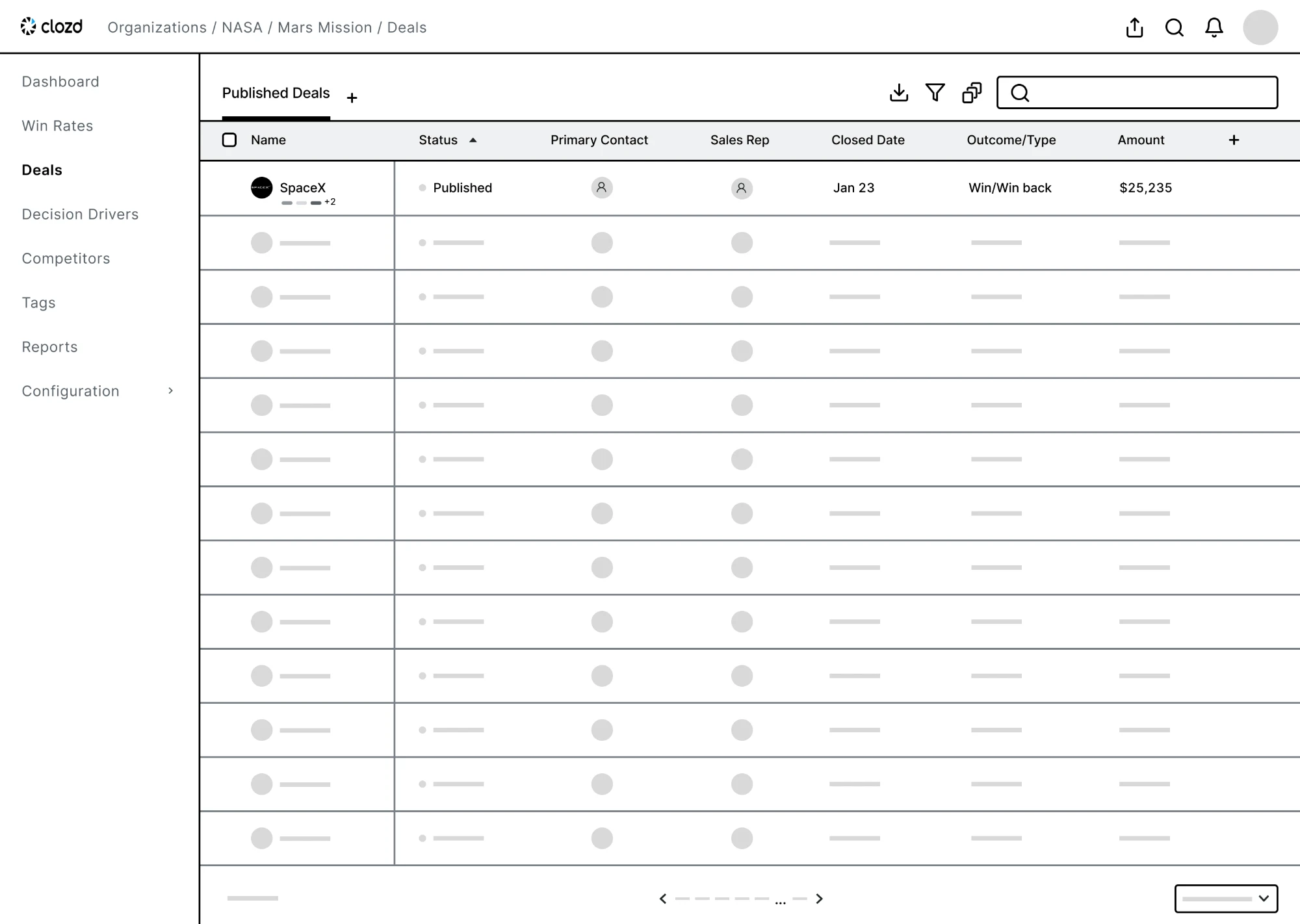
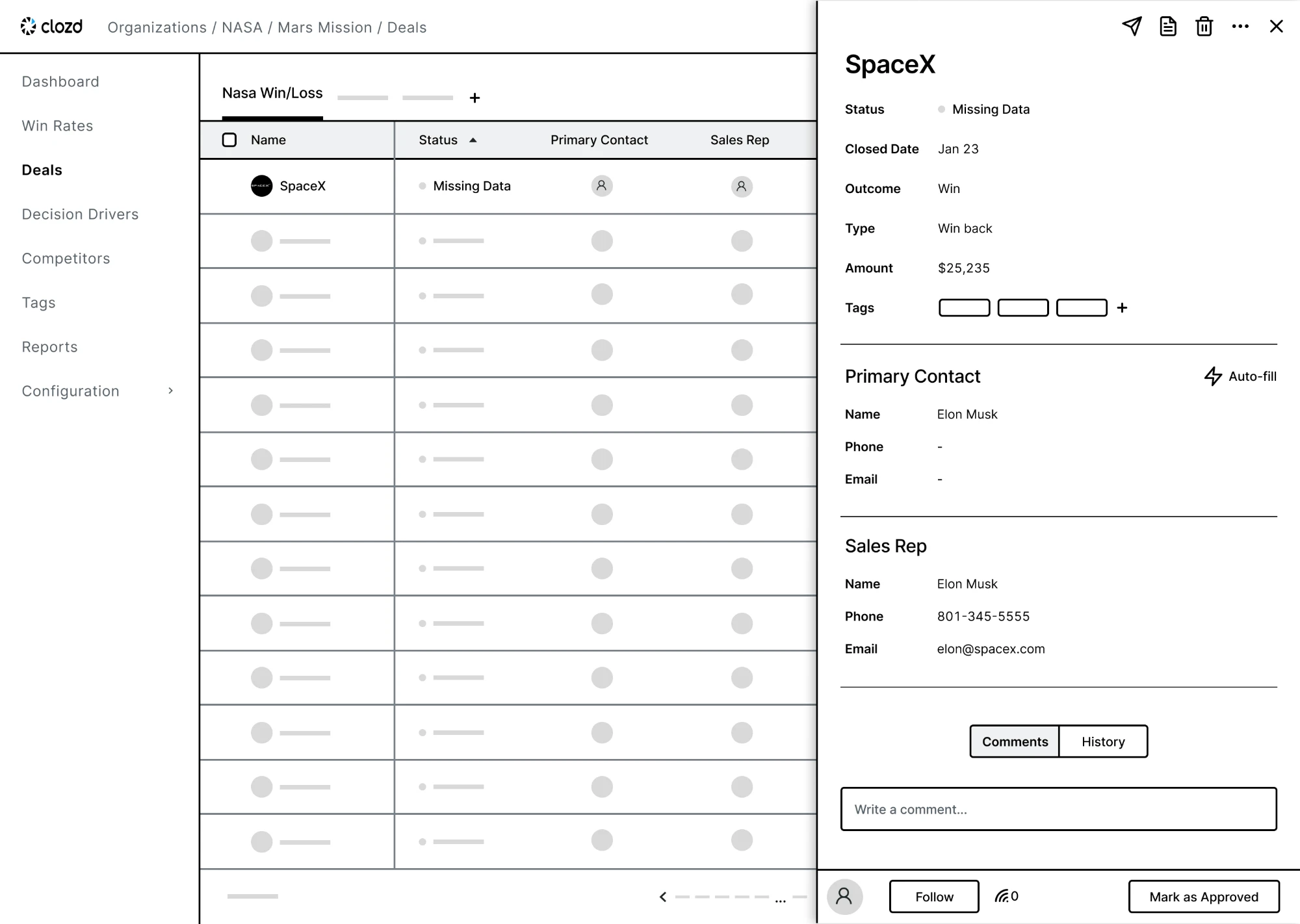
Wireframes from ideation, organized around deals: a deals table, and a deal drawer for filling in contacts and approving. Customers also needed to see the people, which led to the Deals / Participants toggle.
Key decisions
Deals and participants, in one view
My early designs were organized around deals, because that’s how data arrived from the CRM. But customers needed to see the people they were about to contact, and whether the same person showed up on several deals and would hear from them more than once.
Neither view was enough on its own, so I designed a toggle that switches the same list between deals and participants. It kept the CRM’s structure while making the people visible, and it was straightforward to build on the existing data.
One priority order, so no buyer is contacted twice
Customers ran several workflows at once: different products, regions, and deal sizes. If each workflow had its own independent rules, a single deal could match two of them and its buyer would get two requests.
Instead, workflows sit in one priority-ordered list. Each deal goes to the first workflow whose filters it matches, and no further. Customers understood the ordering without help.
Deals that match no workflow go to an Unassigned Deals bucket. Feedback quality depends on reaching as many buyers as possible, so a deal that silently gets no outreach is lost data. The bucket shows customers exactly who they’re missing.
Approvals where sales reps already are
Sales reps know which contacts are right for their deals, but most of them would never log in to Clozd. So I designed a Contributor Portal that reps open from a magic link in an email, with no account or password. There they fill in missing contact details and approve or reject each deal and each buyer for outreach. Admins can override any approval.
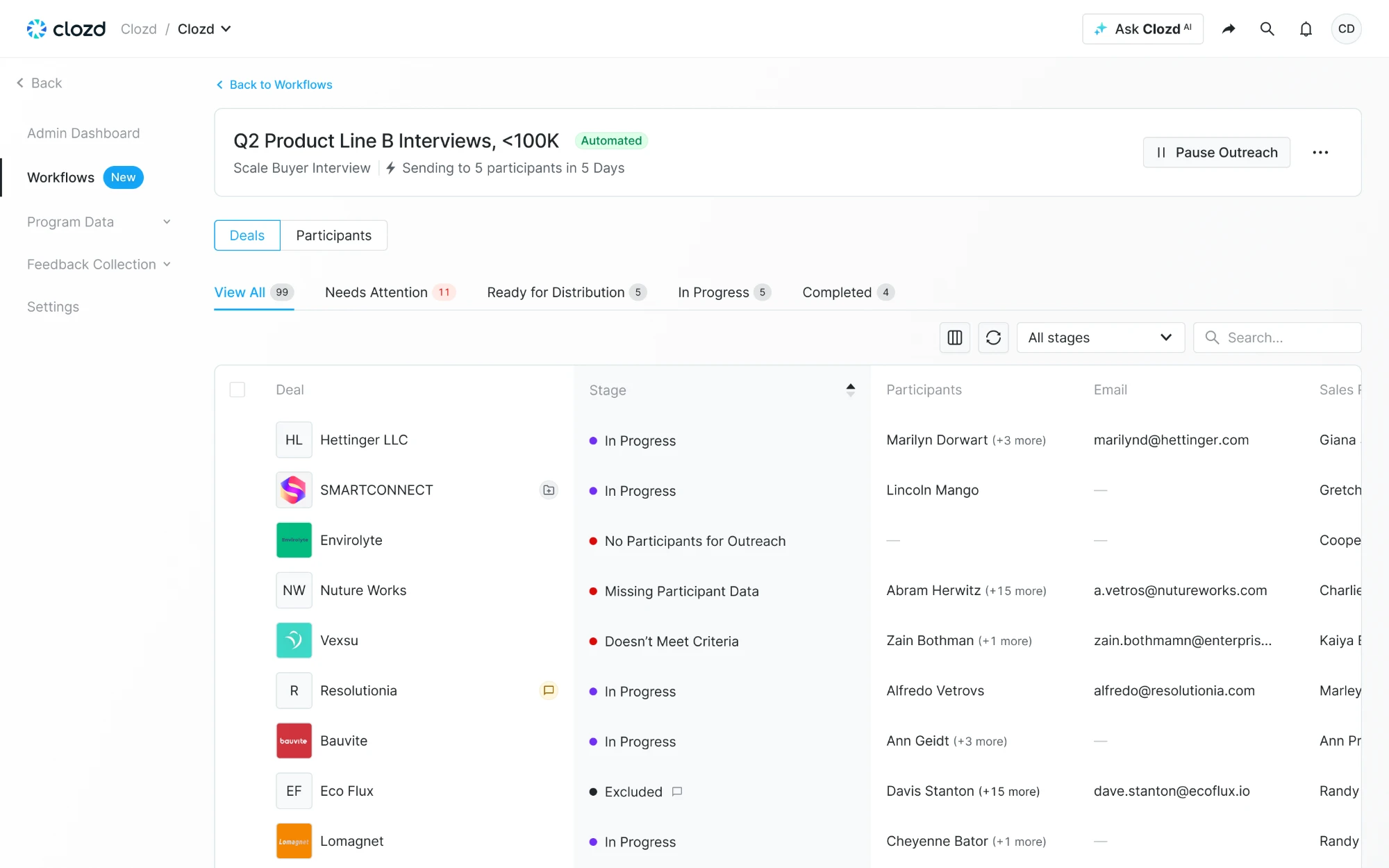
That replaced the spreadsheet loop. Every deal now shows its status and the reason when it’s stuck, such as missing participant data, no participants to contact, or not meeting the criteria.
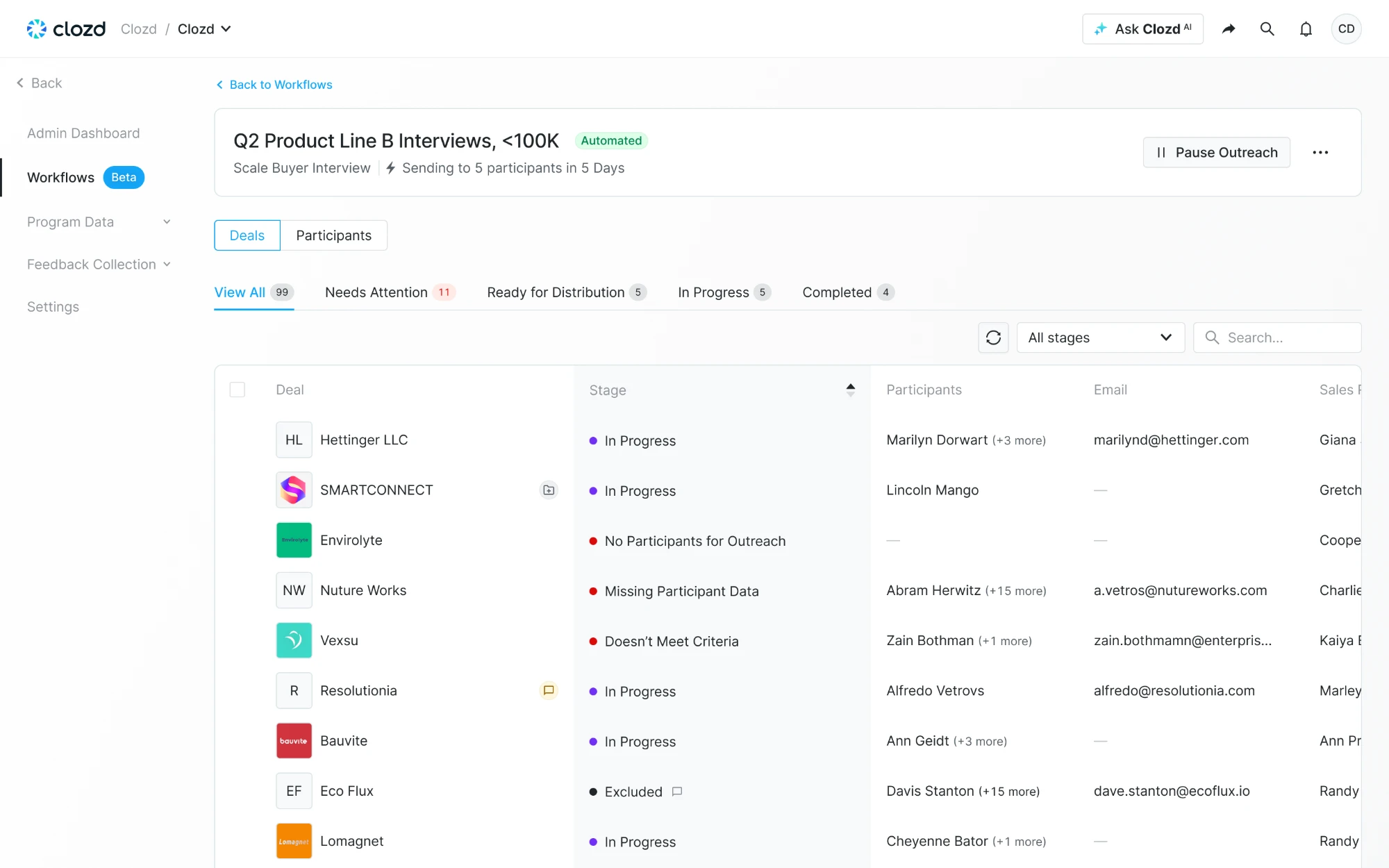
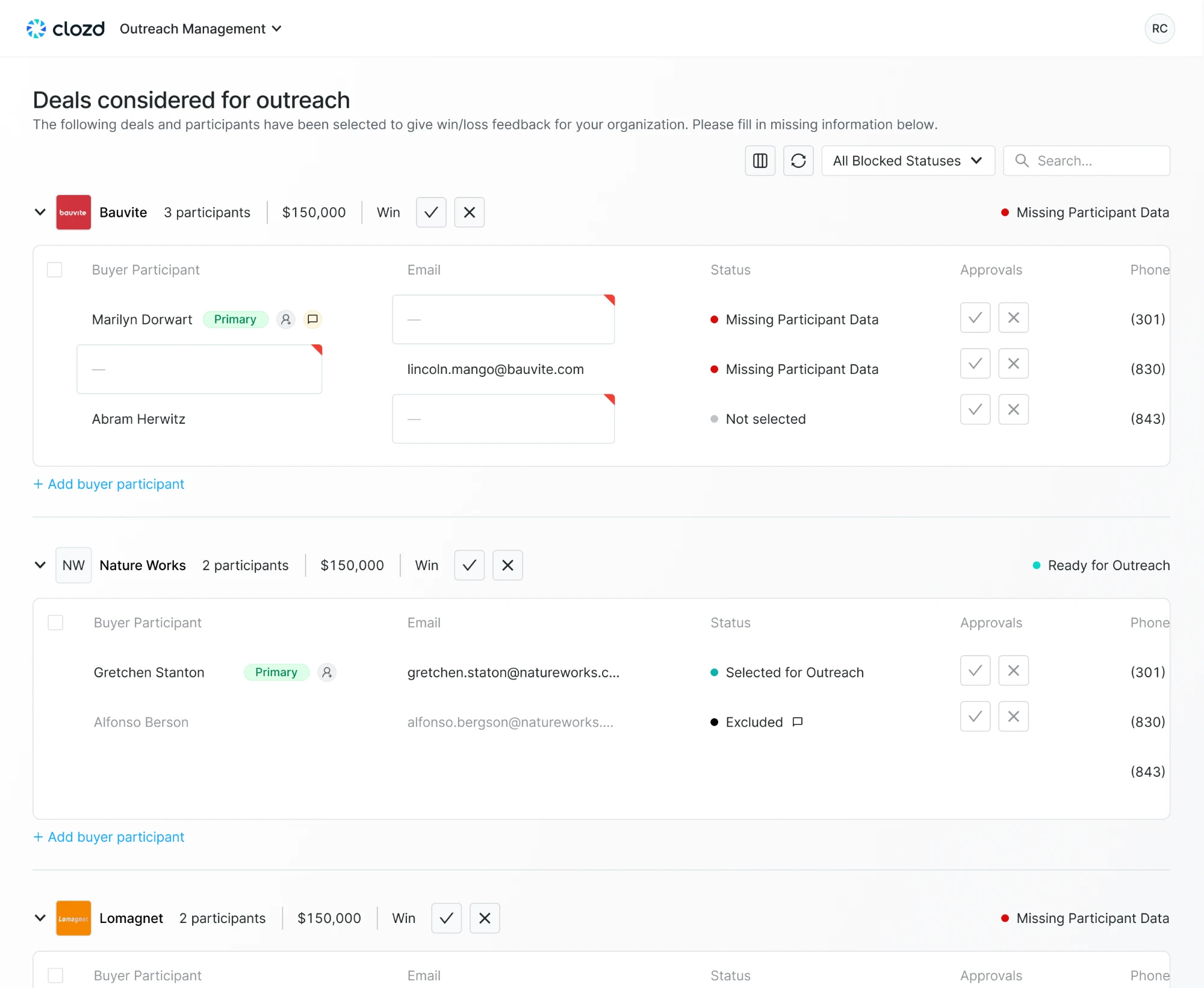
Left: the admin's workflow, where every deal shows why it's stuck. Right: the Contributor Portal, where reps fill in flagged gaps and approve deals and buyers for outreach.
Results
- MVP shipped 4 months after the reset, followed by a second release that automated outreach.
- 25% of customers set up at least one workflow.
- Customers who used Workflows churned at 28% against a 30% baseline: a 2-point drop, or 7% fewer lost customers.
- Companies with 10+ logins in the last 90 days grew from 52 to 79.
- 20% more outreach went out with no manual steps.
- Lists that took weeks came together in days. One enterprise customer went from about four weeks to three or four days.
Metrics measured after launch in Pendo and Clozd's customer success tools. List timing is as reported by Clozd's consultants, not tracked.
Reflection
Make it smaller. Six months of discovery taught me that a plan that takes a long time to make will take a long time to build. Find the smallest release people can use, ship it, and let it shape the next one. The reset worked because it gave everyone something real to react to.
Bring engineering in early. When engineers joined, they surfaced constraints that discovery had missed. Earlier, they would have shaped the plan instead of correcting it.
Move at 70% confidence. We waited until we had every detail, and customer feedback changed things anyway. I’d start sooner and let the beta do the rest.